
A quick reality check on the market you are competing in. New subscription apps now launch at roughly 14,700 per month (up from ~2,000 in early 2022), and the top 10% of apps capture about 94.5% of all subscription revenue. The median app earns only a few hundred dollars a month. The gap between winners and everyone else is almost never the price tag — it is the system around it.
Treat the numbers above as targets to benchmark against, not laws. They come from RevenueCat and Adapty’s 2026 reports, which sample different apps with different definitions — so use them to find your gap, then test your way forward.
1. Get the paywall in front of the right users
The single biggest revenue lever is usually placement: when and to whom you show the paywall. A "hard" paywall (pay before any real access) posts download-to-paid rates around 10.7%, versus 2.1% for freemium — roughly five times higher. But read that stat carefully: hard paywalls do not make people convert better, they filter out low-intent users before they ever count against you. That is the most misused number in mobile monetization.
- Match paywall hardness to your traffic. High-intent channels (App Store search, ASO, branded) tolerate a hard paywall. Discovery traffic (TikTok, Instagram) usually converts better with a soft or contextual paywall after the user feels value.
- Trigger the paywall right after the aha moment — the first time the app obviously delivers value. PhotoRoom shows the paywall right after removing a background; the value is undeniable by then.
- Then test moving it earlier — even before the aha moment, kept dismissible. Rootd 5×’d revenue with an early dismissible paywall; Greg lifted trial sign-ups ~400% by moving the paywall into early onboarding.
- Show the paywall in more than one place (on open, before a locked feature, after onboarding) and trim with testing rather than guessing.
2. Price for value — and localize it
Across the market, weekly plans have quietly become the dominant revenue driver — about 55.6% of all app revenue, up from ~43% in 2023 — while annual’s share fell to roughly 33.6%. Weekly plans paired with a trial often convert several times better than annual, though they need tighter churn management. Monthly tends to underperform both; several winning paywall redesigns simply removed monthly from the main screen.
| Plan | Median price | Notes |
|---|---|---|
| Weekly | $5.99 | Highest revenue share; convert best with a trial; watch first-renewal churn |
| Monthly | $10.00 | Often the weakest tier; consider de-emphasizing on the main paywall |
| Annual | $34.80 | Best retention (50–60% reach 12 months); price ~3× monthly to imply ~75% savings |
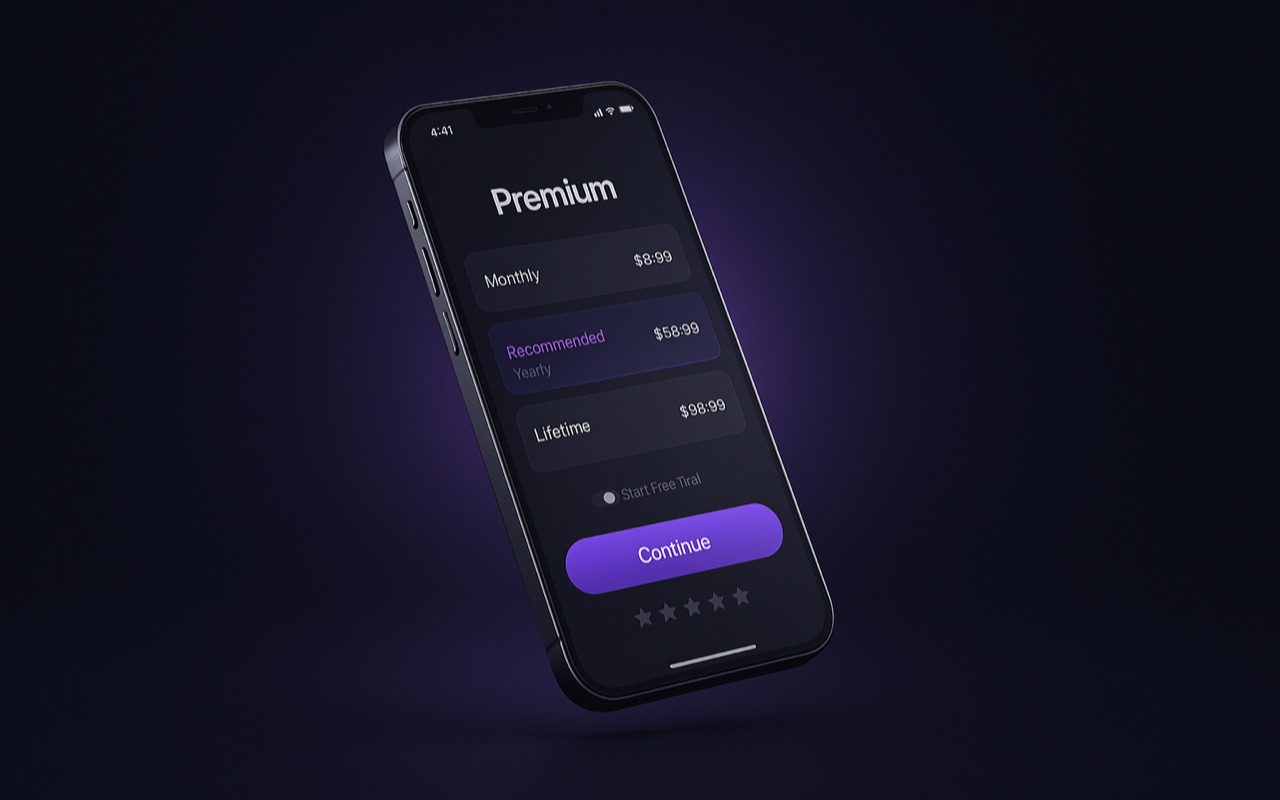
- Anchor the plan you want chosen: show the regular vs current price, the monthly-equivalent of the annual ("just $2.90/mo"), and a clearly labelled "recommended" option. Keep it to 1–3 choices.
- Localize prices per market, do not rely on automatic currency conversion. Europe sustains roughly 20–40% higher prices than North America; emerging markets need lower prices and often different durations. Localization A/B tests lift LTV in ~62% of cases — the single highest-impact experiment type Adapty tracks.
- Most apps are underpriced. Higher-priced tiers deliver stronger lifetime value across every region; raising price for *new* users only is the lowest-risk test you can run, because existing subscribers are grandfathered by default on both stores.
3. Win the free trial
On mobile, trials are effectively opt-out — the store auto-renews unless the user cancels — which is why mobile trial-to-paid runs far higher than web opt-in trials. Global trial-to-paid sits around 25–37% depending on the dataset, and the single most decisive factor is the first day: 80–90% of trial starts happen on day zero. Win the first session and you win most of the trial volume.
- Test trial length deliberately — there is no universal answer. Adapty finds a 5–9 day sweet spot for many apps; RevenueCat finds 17–32 day trials convert ~70% better. Run it on your own users.
- Add a free-trial toggle to the paywall. It makes the trial feel risk-free, lifts immediate revenue, and is a recurring winner in redesigns.
- Send trial reminders before expiry (with the benefit and time remaining), and gate the *right* features: free covers the basic job, premium unlocks the high-value layer.
- Trial-then-paid users retain 1.4–1.7× better than people who buy directly — the trial is a retention tool, not just a conversion tool.
4. Reduce churn and recover failed payments
Acquiring a payer is expensive; keeping one is the cheapest revenue you will ever earn. The top cancellation reasons on Google Play are insufficient usage (37%) and cost (35%) — both addressable — and a large slice of churn is not even voluntary.
- Involuntary churn (failed payments) is 31% of cancellations on Google Play vs 14% on the App Store. Enable grace periods, run billing retries/dunning, and trigger branded push/email on billing-issue events — smart retries recover up to ~30% of failed payments.
- For usage-driven churn, fight it with onboarding, habit loops, and milestone nudges. Only ~24% of users stay past day one, so activation is where retention is won or lost.
- For cost-driven churn, offer a cheaper tier or a pause option instead of a hard cancel, and use a cancellation flow with a required reason so you can show a relevant save offer.
- Build win-back offers for lapsed subscribers. A discounted multi-month offer can beat a free month: "3 months at 50% off" outperformed "1 month free" by ~25% reactivation in one test.
5. Experiment relentlessly
The clearest pattern in the data: teams that test win. Apps running heavy experimentation earn on the order of 40× more than apps that do not, and apps running 50+ paywall experiments have grown revenue up to 100×. The stores do not let you natively show different prices to different users for the same product, so the standard workaround is to create separate offerings (price variants) and split traffic — exactly how RevenueCat, Adapty, and Superwall run price tests.
- Pick one lever at a time: trial length, plan mix, the anchor, base price (±25%), intro-offer type, or localization.
- Measure the full lifecycle, not just initial conversion — a lower price can mean more buyers but less revenue. Lifetime value is the decision metric.
- Run each test long enough to see renewals (often 4–8 weeks), and keep clean, normalized purchase data so the result is trustworthy.
A pragmatic 90-day plan
Weeks 1–3 · Instrument
Pick a subscription/analytics tool, define your aha moment, and get clean funnel + revenue data. You cannot optimize what you cannot measure.
Weeks 4–7 · Paywall & trial
Test placement, a free-trial toggle, plan ordering, and the anchor. These usually move the needle fastest.
Weeks 8–10 · Pricing & localization
Run a price test for new users and localize your top 5 non-US markets. Watch LTV, not just conversion.
Weeks 11–13 · Retention
Turn on grace periods and dunning, add a cancellation save flow, and launch a win-back offer for lapsed users.
Where AI pricing fits
Once your paywall, pricing, and retention basics are solid, the next frontier is personalization — charging closer to each user’s actual willingness to pay instead of a single list price. Because the stores forbid showing arbitrary prices, this is done through eligibility-aware offers and discounts rather than raw price changes. This is the layer Monetai operates in: it predicts each user’s purchase intent and serves a personalized discount only to users who likely need one — designed to focus discounts there rather than on people who would have paid full price, with impact validated via A/B testing. It sits on top of whatever paywall and infrastructure you already use — it is an optimization layer, not a replacement for your purchase backend.
Want to see where your own prices land against the market? Browse live app pricing benchmarks and most-expensive-app data from App Pricing Lab’s daily crawl of 135,000+ apps.